Showing posts with label fantasy. Show all posts

Sunday, February 12, 2012

Pulp Heroes EXPLAINED!...John Carter, you're not so naughty now


The pulp magazines discussed previously (click here) were responsible for the sci-fi genre. Horror sci-fi, like H. P. Lovecraft, and planetary travel sci-fi, like Edgar Rice Burroughs, drew fans out of the serie noire (French crime) and the western pulps.  For novices, Edgar Rice Burroughs not only wrote something other than Tarzan,  he wrote something BETTER than Tarzan!

And now Disney is going to kiddify it! Horrified yet? You should be.

Pulp magazines were written to appeal to a more adult crowd than the comics of the same time period.  They were exploitative, bloody, scary, and full of steam! They depicted hard men, damsels in distress, and twisted criminals. Ever wonder what that family in The Thin Man was hiding behind their big fancy house and secret closet doors? Read the book! Same goes for A Princess of Mars. You'll be even more confused after watching Disney's John Carter, I'd wager.

Why?

I'll tell you!

John Carter is mysteriously immortal.  He has no idea how old he is.  One night after a strange ordeal in a cave, he finds himself pulled to the planet Mars where clothes are considered ugly and unnecessary.  Good thing he arrived there naked as the day he was born! The hulking, 15 feet tall green Martians that Burroughs describes? Disney has made into skinny, Avatar-esque creatures that wouldn't frighten the flea off a Thark's behind! And what of the beautiful Dejah Thoris, the red Martian princess that John Carter falls immediately in love with? Burroughs? Naked as a jay bird.  Disney? Wearing some silly costume only Earth girls would find appealing.

(Not to mention the description of one of the green Martian leaders could be describing Jabba the Hut, and the titles of some of the ranking Martians are suspiciously a predecessor to Jedi.)

The John Carter of Mars books, beginning with A Princess of Mars, are chock full of nakedness, gory battles, more distress than a damsel can shake a stick at, and epic adventure that could not possibly translate to Disney PG-13 (assuming it isn't going to be PG, I've been too scared to check).

When John Carter was first seen around 1918, I'm sure the nakedness of not only the bizarre green Martians, but more particularly of the hero and heroine and everyone in between, was rather shocking to a puritan America.  It is also one of the most strikingly different aspects of life on Mars.  Of course, they weren't depicted as such on the covers of the pulp magazines, but once you crack open the cover, there they were, displayed in all Edgar Rice Burroughs' beauteous descriptives.

There you are.  How can you tell that John Carter is a pulp hero? Exploitation. Damsel. Epic battles. Exotic locales. Heroic adventures. Check, check, check, check, and check.

We can expect none of the exploitation from the movie, I am certain. So, hop onto your Kindle and download A Princess of Mars for FREE, and see what all this pulp heroism is about!

Keep your eyes peeled for more PULP HEROES...EXPLAINED!

Wednesday, February 8, 2012

Filk U! The wonderful world of geek music!

"Hey, Glork! Haven't seen you since ComiCon 1998! Love the new ears.  You make them yourself?"

"Gee, Doff, thanks for noticing! HISlah, I did make them myself. Heghlu'meH QaQ jajvam!"  

"JIjah....I mean..." Glork begins to back away slowly.

"I'm just teasing you!" Doff claps Glork on the back jovially.  "Where are you off to next? Maybe I'll grab the wife and meet you there!"

Quizzically:  "Nugjatlh?"

"The...wife...spouse..."

"Oh...Well, I am going to see the folk music in Room 222."

"Folk music?" A rather rumpled program is retrieved from the waistband of rather snug uniform pants.  "I wondered if this was a typo.  It says 'Filk music...'"

Superior, snorting laughter.  "Indeed it does.  And yes, it is a typographical error.  But it sounds rather catchy, don't you think?"

***
Yes, those were actual words in the language of Klingon. No, I did not make them up.  Yes, you may now kiss my toes.

And that was a dramatized rendition of how the word "filk" came to mean sci-fi/fantasy-based folk music.  A typo in a convention program that was to define a genre and give meaning to many a wandering folk artist with an affinity for the weird.  Filk songs can be about anything near to the hearts of sci-fi fans: vampires, kitty cats, computer, dragons, Star Trek, Lovecraft, comics, etc.  If you happen to be a seasoned filker (someone who is a filk singer/songwriter) you may win a Pegasus Award at the Ohio Valley Filk Fest!

I invite you to plumb the depths of my favorite filk tunes.  So, grab your snake and your plumb bob and enjoy!

Oh, and Hab SoSlI' Quch! (But don't tell her I said so...)

1.  My ultimate favorite filk song does not have a Youtube entry, but you sometimes can find a version to listen to here.  Scroll to the bottom of the page for the lyrics. And all you New-Who fans can bask in the glory of the original Doctor! Cecilia Eng's Grandfather Clock.
It is a Dr. Who-based song using the tune of the old folk song My Grandfather's Clock.  This song defines filk in my humble opinion (see there, that's a good geek phrasing, eh?).

2.  As I am told by my own filk-sensei, Michael of the great frozen north, this next one is the most well-known filk song ever in the history of filkology.  The song won Leslie Fish (hmmm, suspiciously Lovecraftian name..) one of those much coveted Pegasus Awards in 2003. She, however, has stated that she wrote the song as a filler for an album and has regretted it ever since.  That's gratitude for ya! Here are her lyrics, and mind you, there are around a bizillion different versions, but I bring you the original! And for you visual types, the Star Trek version of the video!


3. You may skip the video on this one and just listen.  It is only a picture of Elrond superimposed against the Matrix code, and if you need that explained to you, you've come to the wrong place. Heather  Alexander: Freaking the Mundanes.  That tune is, of course, Waltzing Mathilda.


4.  And my personal favorite.  Also because no horror, filk, or ocean themed blog should be without it, The HP Lovecraft Historical Society's heartwarming, seasonal favorite, "It's Beginning to Look a Lot Like Fishmen."  *Sniffle* May the joy of Dagon be with you this, and every season.


Now that you are armed with the Dr. Scott Refresher Course version of sci-fi music, I bid you to go forth upon the earth and filk!
****
Lyrics: Cecilia Eng-The Grandfather Clock
 Oh, a grandfather clock just appeared in the hall
and it seems very strange to be sure
And a man has come out of the clock in the hall
and is stating some things quite obscure
He seems mildly deranged and a little bit insane
we can make out his words if we try
He says he's the master and we'll obey,
or we all shall die.
So we did as he said after one of us was dead
shrunken down to a tiny toy doll
And we wake up in fright to hear laughter at night
from the man in the clock in the hall
Oh we don't understand all the orders and commands
why he wants to be king in the sky
But he is the master and we'll obey,
or we all shall die
Now a wooden blue box has appeared in the hall
just across from the grandfather clock
And a man has come out of the box in the hall
and his clothes are a bit of a shock
He seems mildly deranged and a little bit insane
and he holds out a featherless hand
He says he's The Doctor and how are we
as he shakes my hand
Now the man in the clock has stepped into the hall
and is holding The Doctor by force
And they talk as we work, like old friends now estranged
as the project continues on course
They seem mildly deranged and a little bit insane
as they talk of strange worlds in the sky
but the master orders and we obey
or we all shall die
Now a darkness and cold has come into our hall
it seems things have gone terribly sour
for the man from the box and the man from the clock
are both trying to cut off the power
as the darkness creeps out they work hard to shut it out
all their differences now laid aside
how we wish they and their darkness would go away
as we try to hide
At the end of the fight day has won over night
and the master has run to his clock
and the man from the box gives a curse as it fades
and his hand passes right through the lock
He seems mildly deranged and a little bit insane
as he screams at the star studded sky
but he is The Doctor and we'll obey
or we all shall die
But he says we are free and returns to his box
and it fades from our now empty hall
And we sigh with relief and a bit of disbelief
as the last weeks events we recall
And we've put the word out sent our messengers about
no more grandfather clock chimes will ring
they've been chopped up never to run again
o'er a time Lord bring

Friday, May 27, 2011

Author Interview: Jacqueline Carey


Jacqueline Carey, the author of the beloved Kushiel series, is an author who is as beloved by her fans as the heroines and heroes in her novels.  In the Kushiel series, a young girl abandoned by her mother and marked by one of the pantheon of angels is trained in the art of pain and secrets by a loving Master.  Thrust into a world of politics and deadly games, she finds love and adventure across a trilogy of exquistly written novels.  The world of Terre d'Ange continues through another 2 trilogies and descendants of the vibrant characters brought to life in Kushiel's Dart.  Through wars, death, love, and betrayal, the generations of characters Jacqueline brings to life in her novels have an uncanny way of worming their way into your heart.  Just ask her adoring fans who keep them alive even beyond the ending of the books!
I was very honored that Jacqueline agreed to let me ask her a few questions and post them on my blog.  Please visit her website and check out some of her novels.
Thanks for reading!
Andrea
* * * * *
Andrea: I wanted to open by saying that I have never identified with a heroine in a book as much as I identified with Phaedre. Shared experiences with her were brought to life when I read your descriptions. In fact, the Kushiel series was the first time I’d ever read anything that I would call remotely “romantic.” Is there something of you in Phaedre? Which character from any of your books do you see as being most like you?


Jacqueline: There’s a bit of me in all my characters, really. As a divinely ordained masochistic courtesan who’s also a genuine heroine, Phèdre is unique in the annals of epic fantasy, and truly a gift of the Muses. Some readers have accused me of being as diabolical as her antagonist Melisande for the complex plots and emotional torments to which I subject my characters! It’s hard for me to be objective, but people who know me well have said the character who most reminds them of me is Sidonie, whose very controlled exterior belies a passionate interior and a somewhat wicked sense of humor.

Andrea:  In other interviews I’ve read, you’ve said that to write, one has to write, which involves a lot of sitting and writing. I was wondering how much your travels have made easier the job of sitting and writing. Do you think you would have been able to weave such a real world in the Kushiel series without your time in London and traveling around the world to exotic places?

Jacqueline: The traveling that I’ve done definitely informs my writing! And no, I don’t think I could have brought my alternate world to life without having a deep well of marvelous and visceral experiences to draw on. Sitting and writing is crucial to developing and honing the craft of writing, but I believe that the more one experiences in life, the more one has to bring to the process.

Andrea:  The very rare bit of fiction I’ve read that centers around the same themes that Phaedre experiences in her own personality and personal life, with submissive female characters dominated by aggressive men, the writing is quite lacking in detail and written more like a Penthouse letter. With the Kushiel series, Phaedre is more than her desires and the life that destiny has given her to live. What research, if any, did you do to be able to create such a real and human character in a world of bondage and slavery?


Jacqueline:  I did a lot of research into the contemporary BDSM community. One of the reasons that consensuality is a sacred tenet in D’Angeline society is that it reflects the level of respect and responsibility that exists in the actual BDSM community. Also, I wasn’t setting out to write erotic fiction; I was writing epic fantasy with a subversive heroine. Phèdre’s sexuality is the most provocative aspect of her character, it’s her strength of will and her refusal to be a victim, her ability to resist despair, that ultimately make her a memorable heroine.

Andrea:  The world that you brought to life in the Kushiel series and that is still going forward with Imriel’s trilogy and now with Naamah’s Blessing is so detailed and dependent on its own unique history, pantheon, and customs. Over the span of so many lengthy novels, what methods do you use to ensure that you don’t contradict something from one book to another or leave out some important element? Have you ever found after a few books that there was an element you wish you had added in from the start?

Jacqueline:  I can’t think of an instance of the latter. As to the former, I wish I could say I had a method, but the truth is that my head is a very crowded place! I do often have to refer back to earlier manuscripts in the process of writing to make sure I’ve maintained consistency.

Andrea:  What methods do you use when you get stuck on a section while writing, or to combat writer’s block?

Jacqueline:  First, never try to force it. That just doesn’t work for me. I’ve been writing long enough to know when I need to step away and get some distance from the problem. I find I do a lot of my best creative mental work when I’m in motion – walking or jogging, or even driving. Although I remember fellow fantasy author Sara Douglass saying she swore by hot baths to cope with writer’s block, too. Whatever works, works!

Andrea:  How much of your writing comes from your life experiences and how much comes from fantasy? I’ve never written what I would call fantasy, but I’m sure it’s different from writing something more contemporary, or even a straight historical novel. Afterall, you have to invent the locations, you can’t go visit them.

Jacqueline:  In terms of worldbuilding, because I’m writing alternate history, I draw extensively on my own experiences. I can’t visit the City of Elua in Terre d’Ange, but I can visit Avignon in the south of France. I can take in the quality of the light as dusk falls over Provence, with the scent of lavender in the air, and find it achingly beautiful. In terms of the characters and plot, well, that’s pretty much entirely a product of my imagination. Obviously, I’ve never been a courtesan, a spy, or a swordsman in real life. I’ve never been abducted and enslaved, never had to make a daring escape, never enduring the fate of an entire realm riding on my shoulders. But I get to do it all in my imagination. That’s what makes writing – and reading – so much fun!

Andrea:  What is your most valued research tool when you’re building on the world in the Kushiel books and its following series?

Jacqueline:  I’d have to say my local library network, which is wonderful. I do a lot of old-fashioned book research, and while I’ll buy some volumes, the library allows me to do extensive background reading without breaking my budget or my already over-crowded bookshelves.

Andrea:  You’ve written Santa Olivia which was a departure from the sort of fantasy world that is Terre d’Ange. Are there any other genres or subgenres you think you may dabble in some day?

Jacqueline:  Oh, for sure! I’m currently working on a new project that’s more of a contemporary urban fantasy, and I suspect some day I’ll tackle a piece of straightforward literary fiction.

Andrea:  Who is the most influential person in your life where your writing is concerned? A friend or family member or teacher who was a motivator or influence on your drive?

Jacqueline:  My biggest supporter was my Great-Aunt Harriett, who passed away a year or so after “Kushiel’s Dart” was released. She’d read earlier, unpublished work, but due to the erotic content, I had a lot of trepidation about letting her read this one. I remember coming home to a message on the answering machine telling me she thought it was absolutely wonderful, adding in an acerbic tone, “And I hope people realize it’s more than just a sex book!” When it won the Locus Award for Best First Novel in 2001, I dedicated the award to her.

Andrea:  You are on Facebook and you have a wonderful website. Do you feel that social media has made publicity for your work much easier? What influence do you feel that the ease of interaction with fans across the internet has had on your writing life?

Jacqueline:  Let me say up front that I’m fortunate in that I enjoy it, and I have a funny, thoughtful, wonderfully diverse group of fans with whom it’s a pleasure to interact. Social media absolutely affords writers a platform that didn’t exist before. That said, there is a downside in that it’s shifted the burden of publicity further onto the writers. We’re expected to utilize social media to promote ourselves and our work to our utmost capacity. It can be a real struggle for writers who aren’t comfortable with it, who are more private and introspective, or simply lack basic techno-savvy. And as much as I do enjoy it, it can be time-consuming, taking away from precious writing hours. It’s a balancing act.

Andrea:   If someone said they were going to make a movie based on Kushiel’s Dart, who would you like to see play the main characters?

Jacqueline:  I’m no good at playing the casting game! I’d rather see who my readers choose. If it were up to me, I’d probably want to go with a bunch of incredibly talented unknowns who don’t bring any media baggage.

Andrea:  With the increase in self-publishing thanks to the popularity of ebook readers, how do you feel about the new tools available to writers to get their work out there? Many writers who would never have been published are able to self-publish and publish via ebook. The downside of that is that there is a lot of less than stellar stuff to sift through if you’re looking for a good, new read. Do you see this as a viable option for beginning writers?

Jacqueline:  As of this writing, I’d say yes, if you’re good at marketing and self-promotion. There have been a few amazing success stories. However, the ebook market’s still in a state of flux. If traditional publishers decide to lower the prices on ebooks to be more competitive with self-published writers, I think that will limit their opportunities. Not that I’m sure it’s going to happen; I just don’t think the market’s really found its base level yet.

Andrea:  Now that we’re devouring Naamah’s Blessing and a new trilogy, are there any other projects you’re working on?

Jacqueline:  There’s the aforementioned contemporary urban fantasy – which is really a small-town fantasy – but it’s not in a place where I’m ready to divulge details yet. And I just finished proofreading “Saints Astray,” which is the sequel to “Santa Olivia,” coming out in November of this year.

Andrea:  What do you consider the best piece of advice to aspiring authors?

Jacqueline:  I’m going to cheat and crib from my own FAQ on www.jacquelinecarey.com, because I put a lot of thought into this one, and I don’t think I can top it: It's hard to give advice on writing, because the best way to learn is through doing. No two writers work the same way, and everyone has to find their own path. So… write. Write a lot. Build a world and explore it. Create characters and break their hearts. Take risks, and don't be afraid to make mistakes. Experiment. All the methodology -- whether to outline in advance or wing it, write in a linear fashion or skip around, follow a rigid schedule or go with the flow of inspiration, edit as you write or worry about it later -- emerges with experience. As you write, you'll discover what works for you.

Andrea:  Is there anything else you would like to say or information you would like to give?

Jacqueline:  Thanks for reading!

Sunday, October 24, 2010

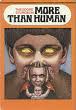
Book Review: More Than Human

Title:  More Than Human
Author:  Theodore Sturgeon
Publishing date:  1953
Number of pages:  188
Recommended for:  Ages 12 and up

Gestalt:  A physical, biological, psychological, or symbolic configuration of elements so unified that its properties cannot be derived from a simple summation of its parts.

The style of Theodore Sturgeon, like the style of Ray Bradbury, is more poetic than prose.  Being the logophile that I am, it took an extraordinarily long amount of time to read this because I kept going back and rereading several paragraphs just for the pleasure of consuming them again.

More Than Human tells the story of a human gestalt, five beings with unique talents who, upon finding each other, become irreducible to their collective parts.  They become something more, something powerful. 

The Head:  Lone, a 25 year old innocent homeless man who "lived in a black and gray world, punctuated by the white lightning of hunger and the flicker of fear." Called The Idiot, Lone must pull the parts together to make the whole and muddle through his childlike thoughts to help it function.

The Brain:  Baby, an infant with Down Syndrome, rescued by Lone, who never grows, never speaks aloud, but functions as a human computer.

The Feet:  A set of twins who can teleport and reach things that the gestalt needs but cannot get to.  They also speak to Baby telepathically.

The Hands:  A young girl, kicked out of her home at the age of 8, gifted with telekinesis

More Than Human was originally a novella entitled Baby is Three.  Sturgeon added a beginning section and an ending section and published it as a novel, which was later made into a graphic novel illustrated by Alex Nino, called Heavy Metal Presents: More Than Human.

In the first section, The Fabulous Idiot, the reader is introduced the separate portions of the gestalt, how they lived, and how they met and became a whole.  The most poetic portion of the book, The Fabulous Idiot paints the picture of the tragic lives and events that shaped the outcasts. 

In the second segment, Baby is Three, the reader is introduced to another important character who will reshape the path of the gestalt.  Several years have passed since The Fabulous Idiot and the gestalt is changing.  The whole moves closer to a more evolved consciousness while trying to find a place for itself in the world.

In the final section, Morality, several more years have passed and the gestalt has become something altogether different from what The Idiot intended.  Slowly, in a reversed telling, the events of the past few years are revealed and what is lacking in the gestalt begins to come clear.

The book is a wondrous build-up of events that are never what the reader expects to see.  Characters grow and change and leave in times and ways that are wholly unpredictable.  However, the final segment is on the confusing side and, though the new character is endearing and beautiful, seems as though the author simply grasped at some way to add an ending.  It felt as though the story would have benefited in another segment between Baby  is Three and Morality, showing some of the events that are mostly hinted at in the final section.  I had to consider what the author was meaning and fill in some blanks myself in order to believe the ending.  Even so, the book was phenomal from the standpoint of the craft of writing and characterization. It was also a great one for National Down Syndrome Month (October)!

This was a book that was beloved my father and one he had wanted me to read for years.  I am glad that I took the time to read it. While flawed, especially with the forced ending, it was still very endearing.  Now I am off to track down that graphic novel!


Recommended for fans of Marvel comics, fantasy, and beautiful writing.  Appropriate for all ages, but probably most effective for ages 12 and up.

Tuesday, September 28, 2010

Howl's Moving Castle by Diana Wynne Jones

I attempted to take my children to New Orleans to see Howl's Moving Castle at the Canal Street theatre, the closest place to my home that was showing it and that was about four hours away.  Unfortunately, when we attempted to go the 2nd night we were there the film had broken of the English dubbed version.  My kids were very young then and incapable of reading the subtitles as quickly as they went by.  We were crushed, needless to say and sat in the lobby of the old theatre trying to figure out what to do from that point on.  The ushers felt sorry for us and got the manager who let us see March of the Penguins for free.  It was great, but not what we had wanted.

When we finally got to see the film, I fell in love with it of course, like with all of Miyazaki's work.  Howl was a lovely-drawn character with a depth that was impossible to hit on in a short movie.  Events were hinted at that stuck with me, sparking my imagination to figure out what they meant and what was going on behind the scenes outside the main plot of the movie.  Of course I had no idea there was a book!

It was written when I was a child and was something I would have adored.  But I think I appreciated it more having discovered it at this age.  Isn't that the way it is with so much of what we see in life? True appreciation only comes with age, just as Sophie learned in the book.

The novel is written in a fast-paced, entertainingly worded prose that carried me through the novel at such a rapid pace that I don't remember much else of the three days I spent reading it between homework assignments and driving kids about.  It is the perfect supliment to the movie. Wait, strike that, reverse it.

While the basic plot of Howl, Sophie, and Calcifer trying to break curses remains intact, and a few of the subplots, there are even more! The movie weaves several threads of the story together so that we get a breathtaking view of the world in which Howl operates.  But the book takes us there.  Through all the doorways, across the Waste, and into modern day Wales!

Sophie's family even has a major plot line! Watching the movie does not spoil anything about the book! You may think you will know how it ends, but do not be so sure! I fell in love with Howl all over again, seeing him as even more of a womanizing rogue in the novel than they dare portray in the movie.  I would classify the novel as fantasy, but it is not the sort of fantasy that takes all your concentration attempting to envision alien lands, pronounce impossible names with too many vowels, and wading through chapter upon chapter of history and genealogy.  It is humorous, heartwarming, tense, scary, and romantic.  If you've seen the movie, you have not seen the whole story.  I am in the process of tracking down more of Diana Wynne Jones' work.

Thursday, September 16, 2010

My Reading Challenge

On the right hand sidebar of my blog I've listed about 60 or 70 books that I've never read.  The school I attended until my last few high school years did not have a focus on literature for whatever reason, so the books that are often required reading for high schoolers, I never read. Of course, I was never seen without a book in my face. Cheerleading practice, I was sitting with a book until everyone got there (usually a horror novel to gross out the other girls).  In the dressing room at ballet school I was reading (usually a novel or biography of famous prima ballerinas or primier danseurs).  And in bed at night or in my treehouse I was usually reading some spanning epic like Count of Monte Cristo or Anna Karenina or Gone With the Wind.

History in novels was always an attraction for me.  The Alienist, Sherlock Holmes, the French Revolution, Jack the Ripper, the Spanish Inquisition.  I read Count of Monte Crist, of over 1000 pages, when I was 14! But I didn't read Anne Frank's diary. I read Hamlet when I was 12, but I didn't have the required (for other schools) Julius Caesar.

So what I've done here is look over twenty or so greatest books lists, and seek suggestions from others which did not go over well (forcing me to assume that the majority of people I know do not read), and compile a list of what I think are great novels that I have never read, or read so long ago that I do not remember enough about them.  I tried to pick works from across the board: German, Netherlands, Asia, Europe, Britain, America, men, women, classics, modern, horror, science fiction, fantasy, tear-jerkers, young adult, exploitative, political, etc.

I've toyed with the notion of creating a 2nd list of the greatest short stories or poems that I've not read because these are often over looked and have contributed to the advancement of the culture as much as novels.  We'll see. I have an ambitious list already!

I would like anyone who happens upon this blog to post a comment with any book, short story, poem, etc. that should be on my list but isn't.  Just put whether it is a novel, short story, etc. out to the side and the author if known.  I don't anticipate finishing this in any short time span, and I'm sure that I will close a few of them after 100 pages and never pick them up again.  The point isn't to torture myself; the point is to enrich my knowledge of what is out there to be consumed.

Tuesday, September 7, 2010

Book Review: The Giver by Lois Lowry

The Giver by Lois Lowry (1993)
Pages:  179
My age recommendation: 5th grade through adult
Awards: Newbury Medal
Other novels by the author: Number the Stars, The Messenger


I believe that too often, young adult literature is discounted as being for "kids" or without enough substance to keep adults engaged.  Having actually grown out of caring what Stephen King bangs out on a keyboard, and very hesitant to spend exorbitant amounts on authors I've never heard of, I decided to take my 12 year old daughter's advice and read a book that she read for a book report in 6th grade last year.  I made the same assumptions, it was going to be too childish to keep my attention though her description of it was intriguing.  The essential elements of life were not going to be touched on at all because those things are not "for children" in the minds of most adults.  And besides, it was on the approved reading list for the Accelerated Reader program!

I could not have been more wrong.  What followed over the two days I took to read this bleak and heart-wrenching tale of a future so far away that it almost seems a part of the past was a tear-filled, anxious journey through what could be an all too real destiny for the human race.

Confined to remain in one of the Communities, young Jonas is preparing for the Ceremony of the Twelves, when he will be given his adult job and no longer be considered a child.  He is a good student, obedient, rarely in need of Chastisement.  He cares for his younger sister, a Six named Lily.  But his orderly life is about to be tossed into mortal turmoil when he finds that he has not been selected for a job, but Chosen to be the Receiver of all the memories that have been painstakingly erased from the human consciousness over centuries: memories of war, broken bones, sunburns, death, the loss of loved ones, hunger, poverty, and fear.  But other memories are there, too, waiting to change his life forever:  memories of colors, sexuality, love, exhilaration, and celebrated differences between human beings.

In the world where Jonas lives, Climate Control and Sameness became important issues hundreds of years before his birth.  Colors were erased from human perception so that everyone and everything took on shades of gray.  The landscape became even, flat, without rises and hills and mountains and valleys.  Food is distributed in equal amounts to every Citizen.  Children are called Males and Females.  Pills are subscribed daily to suppress Stirrings of desire and sexuality.  The job of Birthmother to produce newchildren for the Family Units is one without honor.  Rain, snow, storms, and temperature change do not exist in the memories of anyone except the Receiver of the memories who is destined to live in sadness and pain and loneliness, bearing the memories so no one else has to.

The Giver has many elements of George Orwell's 1984 and George Lucas' THX 1138.  It paints the picture of a future that on the surface seems ideal, without describing exactly what life is like for the Citizens of the Community.  As life begins to unfold and the eyes of Jonas are opened, we become aware that with all of the pain in our world, we could not erase it without erasing the joy as well.  Racial differences are obscured, but gone is the realization of beauty in every human being, in sparkling eyes, in varying shades of hair and skin.  In those conditions, we do become just Citizens, Male and Female, not men and women and human beings.

The book is short but is full of substance.  There are also two companion books, not sequels, but stories of other Citizens that I want to track down and read soon.  The author's use of language is captivating and her ability to make the reader feel shock, anger, and amazement is uncanny.  Fans of futuristic fantasy, sci-fi, and social commentary would love this novel.

This book was captivating.  I recommend it wholeheartedly to adults and young people 11 and over.  It was one of the best books I've read in a while.  Lois Lowry brings new ideas to concepts that have worried humanity for generations.  Be prepared to look at life differently.